
The People’s Power Movement
Press Statement for Immediate Release
February 16, 2026
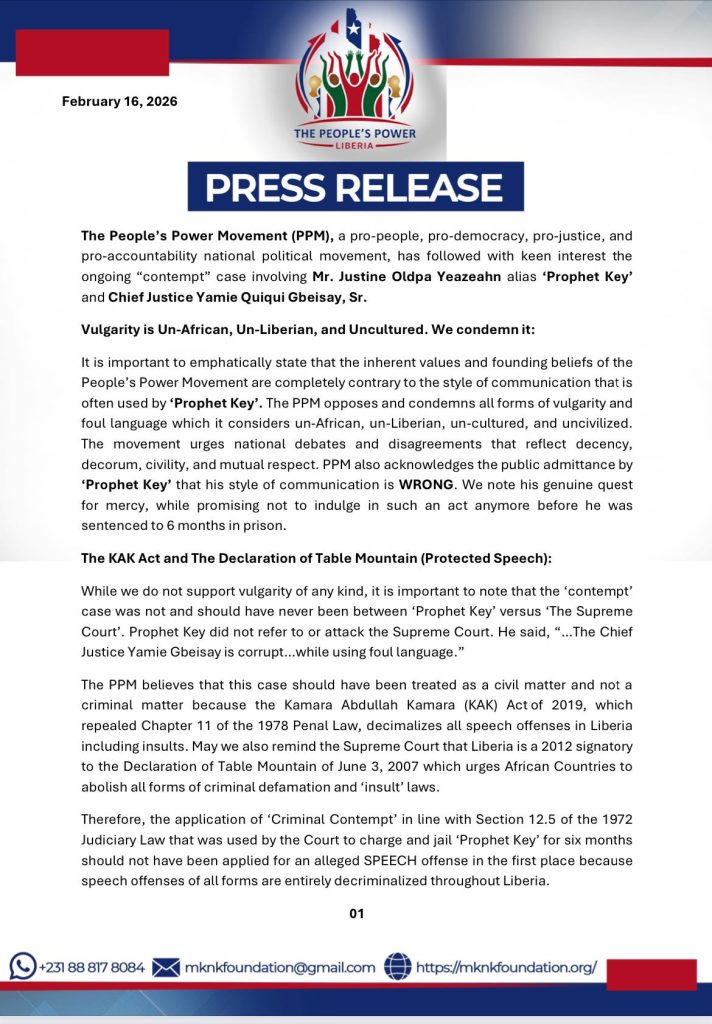
The People’s Power Movement (PPM), a pro-people, pro-democracy, pro-justice, and pro-accountability national political movement, has followed with keen interest the ongoing “contempt” case involving Mr. Justine Oldpa Yeazeahn alias ‘Prophet Key’ and Chief Justice Yamie Quiqui Gbeisay, Sr.
Vulgarity is Un-African, Un-Liberian, and Uncultured. We condemn it:
It is important to emphatically state that the inherent values and founding beliefs of the People’s Power Movement are completely contrary to the style of communication that is often used by ‘Prophet Key’. The PPM opposes and condemns all forms of vulgarity and foul language which it considers un-African, un-Liberian, un-cultured, and uncivilized. The movement urges national debates and disagreements that reflect decency, decorum, civility, and mutual respect. PPM also acknowledges the public admittance by ‘Prophet Key’ that his style of communication is WRONG. We note his genuine quest for mercy, while promising not to indulge in such an act anymore before he was sentenced to 6 months in prison.
The KAK Act and The Declaration of Table Mountain (Protected Speech):
While we do not support vulgarity of any kind, it is important to note that the ‘contempt’ case was not and should have never been between ‘Prophet Key’ versus ‘The Supreme Court’. Prophet Key did not refer to or attack the Supreme Court. He said, “…The Chief Justice Yamie Gbeisay is corrupt…while using foul language.”
The PPM believes that this case should have been treated as a civil matter and not a criminal matter because the Kamara Abdullah Kamara (KAK) Act of 2019, which repealed Chapter 11 of the 1978 Penal Law, decimalizes all speech offenses in Liberia including insults. May we also remind the Supreme Court that Liberia is a 2012 signatory to the Declaration of Table Mountain of June 3, 2007 which urges African Countries to abolish all forms of criminal defamation and ‘insult’ laws.
Therefore, the application of ‘Criminal Contempt’ in line with Section 12.5 of the 1972 Judiciary Law that was used by the Court to charge and jail ‘Prophet Key’ for six months should not have been applied for an alleged SPEECH offense in the first place because speech offenses of all forms are entirely decriminalized throughout Liberia.
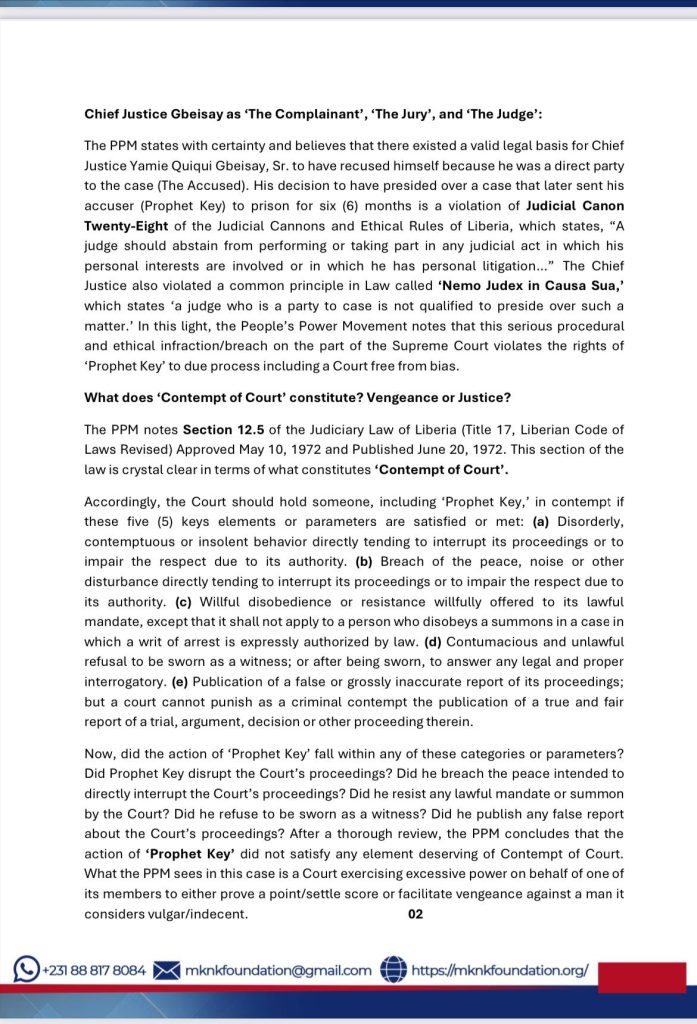
Chief Justice Gbeisay as ‘The Complainant’, ‘The Jury’, and ‘The Judge’:
The PPM states with certainty and believes that there existed a valid legal basis for Chief Justice Yamie Quiqui Gbeisay, Sr. to have recused himself because he was a direct party to the case (The Accused). His decision to have presided over a case that later sent his accuser (Prophet Key) to prison for six (6) months is a violation of Judicial Canon Twenty-Eight of the Judicial Cannons and Ethical Rules of Liberia, which states, “A judge should abstain from performing or taking part in any judicial act in which his personal interests are involved or in which he has personal litigation…”
The Chief Justice also violated a common principle in Law called ‘Nemo Judex in Causa Sua,’ which states ‘a judge who is a party to case is not qualified to preside over such a matter.’ In this light, the People’s Power Movement notes that this serious procedural and ethical infraction/breach on the part of the Supreme Court violates the rights of ‘Prophet Key’ to due process including a Court free from bias.
What does ‘Contempt of Court’ constitute? Vengeance or Justice?
The PPM notes Section 12.5 of the Judiciary Law of Liberia (Title 17, Liberian Code of Laws Revised) Approved May 10, 1972 and Published June 20, 1972. This section of the law is crystal clear in terms of what constitutes ‘Contempt of Court’.
Accordingly, the Court should hold someone, including ‘Prophet Key,’ in contempt if these five (5) keys elements or parameters are satisfied or met: (a) Disorderly, contemptuous or insolent behavior directly tending to interrupt its proceedings or to impair the respect due to its authority. (b) Breach of the peace, noise or other disturbance directly tending to interrupt its proceedings or to impair the respect due to its authority. (c) Willful disobedience or resistance willfully offered to its lawful mandate, except that it shall not apply to a person who disobeys a summons in a case in which a writ of arrest is expressly authorized by law. (d) Contumacious and unlawful refusal to be sworn as a witness; or after being sworn, to answer any legal and proper interrogatory. (e) Publication of a false or grossly inaccurate report of its proceedings; but a court cannot punish as a criminal contempt the publication of a true and fair report of a trial, argument, decision or other proceeding therein.
Now, did the action of ‘Prophet Key’ fall within any of these categories or parameters? Did Prophet Key disrupt the Court’s proceedings? Did he breach the peace intended to directly interrupt the Court’s proceedings? Did he resist any lawful mandate or summon by the Court? Did he refuse to be sworn as a witness? Did he publish any false report about the Court’s proceedings? After a thorough review, the PPM concludes that the action of ‘Prophet Key’ did not satisfy any element deserving of Contempt of Court. What the PPM sees in this case is a Court exercising excessive power on behalf of one of its members to either prove a point/settle score or facilitate vengeance against a man it considers vulgar/indecent.
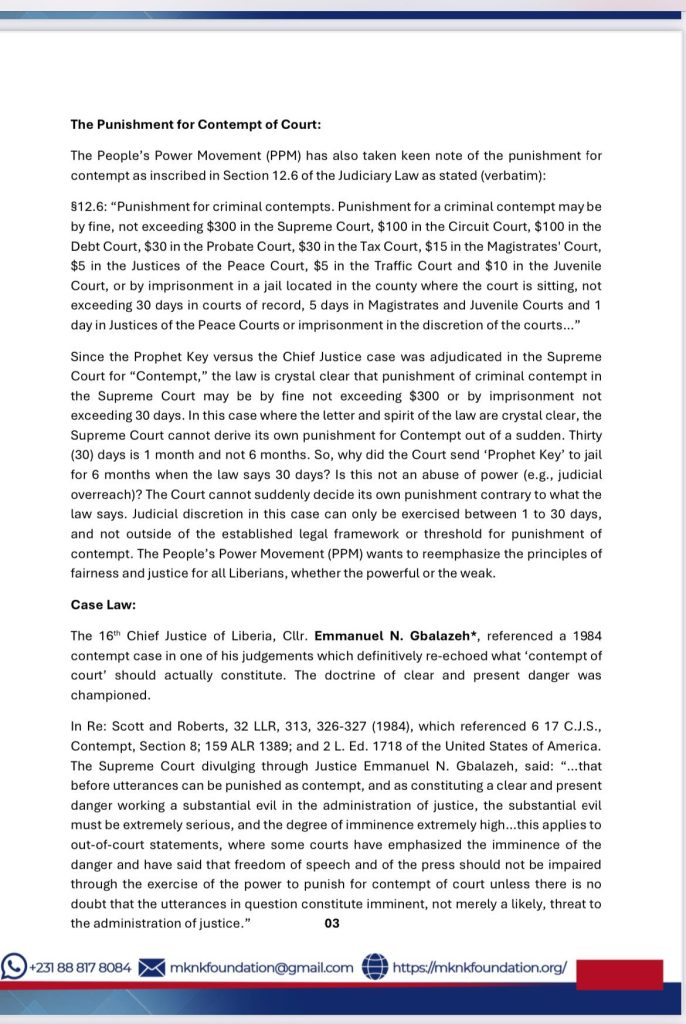
The Punishment for Contempt of Court:
The People’s Power Movement (PPM) has also taken keen note of the punishment for contempt as inscribed in Section 12.6 of the Judiciary Law as stated (verbatim):
§12.6: “Punishment for criminal contempts. Punishment for a criminal contempt may be by fine, not exceeding $300 in the Supreme Court, $100 in the Circuit Court, $100 in the Debt Court, $30 in the Probate Court, $30 in the Tax Court, $15 in the Magistrates’ Court, $5 in the Justices of the Peace Court, $5 in the Traffic Court and $10 in the Juvenile Court, or by imprisonment in a jail located in the county where the court is sitting, not exceeding 30 days in courts of record, 5 days in Magistrates and Juvenile Courts and 1 day in Justices of the Peace Courts or imprisonment in the discretion of the courts…”
Since the Prophet Key versus the Chief Justice case was adjudicated in the Supreme Court for “Contempt,” the law is crystal clear that punishment of criminal contempt in the Supreme Court may be by fine not exceeding $300 or by imprisonment not exceeding 30 days. In this case where the letter and spirit of the law are crystal clear, the Supreme Court cannot derive its own punishment for Contempt out of a sudden. Thirty (30) days is 1 month and not 6 months. So, why did the Court send ‘Prophet Key’ to jail for 6 months when the law says 30 days? Is this not an abuse of power (e.g., judicial overreach)? The Court cannot suddenly decide its own punishment contrary to what the law says. Judicial discretion in this case can only be exercised between 1 to 30 days, and not outside of the established legal framework or threshold for punishment of contempt. The People’s Power Movement (PPM) wants to reemphasize the principles of fairness and justice for all Liberians, whether the powerful or the weak.
Case Law:
The 16th Chief Justice of Liberia, Cllr. Emmanuel N. Gbalazeh*, referenced a 1984 contempt case in one of his judgements which definitively re-echoed what ‘contempt of court’ should actually constitute. The doctrine of clear and present danger was championed.
In Re: Scott and Roberts, 32 LLR, 313, 326-327 (1984), which referenced 6 17 C.J.S., Contempt, Section 8; 159 ALR 1389; and 2 L. Ed. 1718 of the United States of America. The Supreme Court divulging through Justice Emmanuel N. Gbalazeh, said: “…that before utterances can be punished as contempt, and as constituting a clear and present danger working a substantial evil in the administration of justice, the substantial evil must be extremely serious, and the degree of imminence extremely high…this applies to out-of-court statements, where some courts have emphasized the imminence of the danger and have said that freedom of speech and of the press should not be impaired through the exercise of the power to punish for contempt of court unless there is no doubt that the utterances in question constitute imminent, not merely a likely, threat to the administration of justice.”
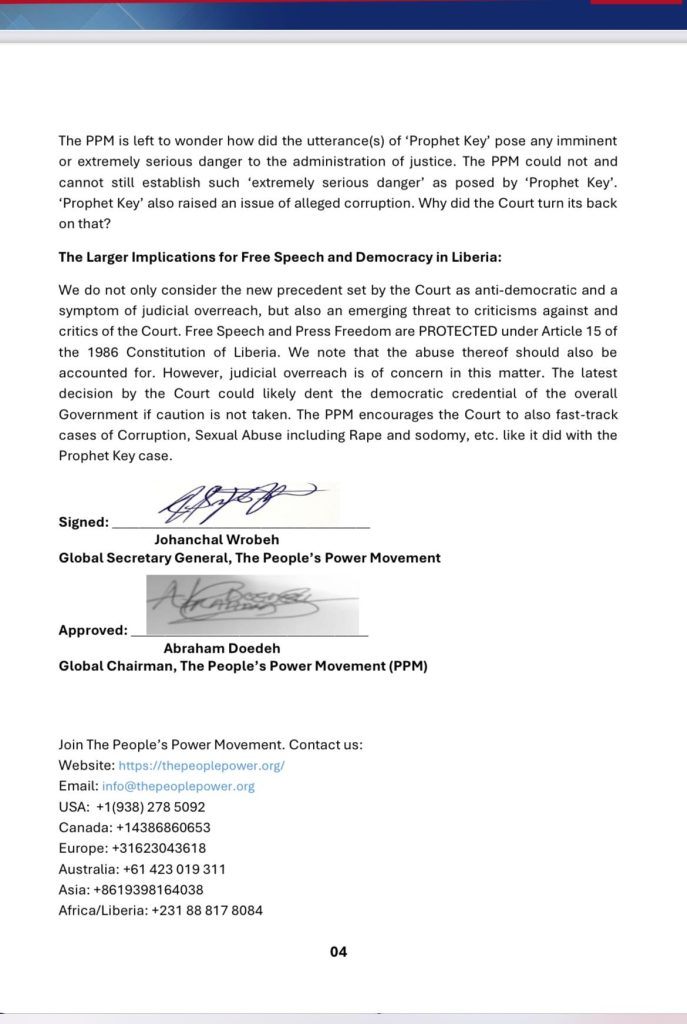
The PPM is left to wonder how did the utterance(s) of ‘Prophet Key’ pose any imminent or extremely serious danger to the administration of justice. The PPM could not and cannot still establish such ‘extremely serious danger’ as posed by ‘Prophet Key’. ‘Prophet Key’ also raised an issue of alleged corruption. Why did the Court turn its back on that?
The Larger Implications for Free Speech and Democracy in Liberia:
We do not only consider the new precedent set by the Court as anti-democratic and a symptom of judicial overreach, but also an emerging threat to criticisms against and critics of the Court. Free Speech and Press Freedom are PROTECTED under Article 15 of the 1986 Constitution of Liberia. We note that the abuse thereof should also be accounted for. However, judicial overreach is of concern in this matter. The latest decision by the Court could likely dent the democratic credential of the overall Government if caution is not taken. The PPM encourages the Court to also fast-track cases of Corruption, Sexual Abuse including Rape and sodomy, etc. like it did with the Prophet Key case.
Signed:
Johanchal Wrobeh
Global Secretary General, The People’s Power Movement
Approved:
Abraham Doedeh
Global Chairman, The People’s Power Movement (PPM)
Join The People’s Power Movement. Contact us:
Website: https://thepeoplepower.org/
Email: info@thepeoplepower.org
USA: +1(938) 278 5092
Canada: +14386860653
Europe: +31623043618
Australia: +61 423 019 311
Asia: +8619398164038
Africa/Liberia: +231 88 817 8084

Leave a Reply